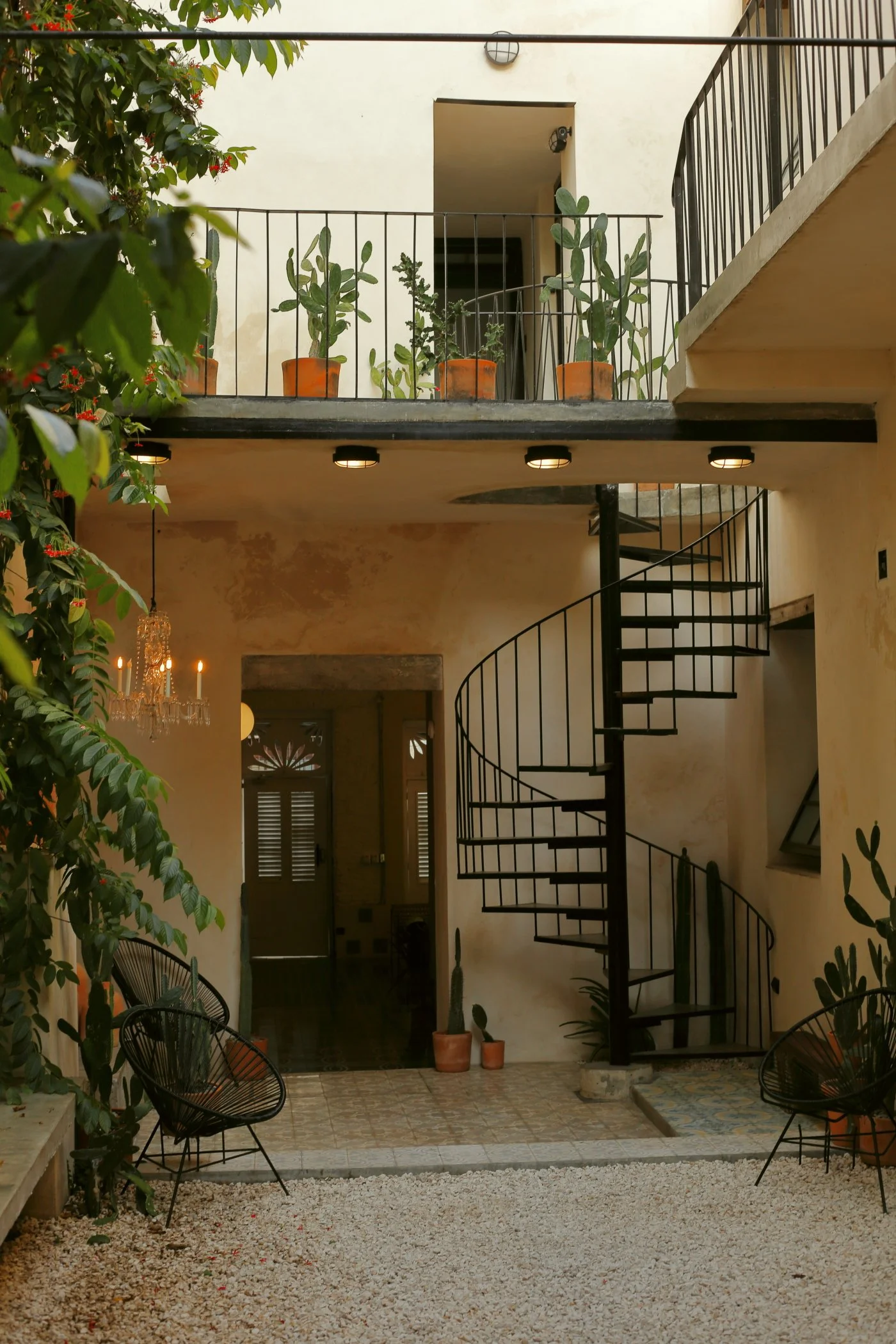
How a Historic Colonial Building Became a Boutique Villa in Santo Domingo

Fixie Lofts began as a personal project: to create a different kind of place to stay in Santo Domingo — one based on space, light, and independence.
From idea to reality
We are Mey and Jose, a Venezuelan-Spanish couple with a shared interest in architecture, travel, and historic spaces.
During a visit to Zona Colonial, we saw a neighborhood in transformation — becoming calmer, more walkable, and increasingly attractive for travelers.
It reminded us of similar areas in Latin America, such as Cartagena and Panama City, where historic centers had evolved into vibrant places to stay.
We decided to create a space designed specifically for independent travelers.
Finding the right place
After months of searching, we found a colonial house with something unusual: a hidden structure of historic arches and thick rammed-earth walls.
Even in its deteriorated state, the architectural value was clear.
The project required a full restoration — rebuilding the property while preserving its original character.
A connection to early Santo Domingo
During the restoration, we discovered that the structure was connected to the Hospital San Nicolás de Bari, the first hospital built in the Americas (1503–1508).
Parts of the original walls and arches remain integrated into the villa today.
This connection places the property within the earliest urban development of Santo Domingo.

San Nicolás de Bari, 1503, Unesco Site.
Restoration and design approach
We chose to restore rather than rebuild.
Working with existing structures is not only more sustainable, but also preserves the character of historic architecture.
The original walls — over 70 cm thick — were maintained using traditional lime-based materials to retain their thermal and acoustic properties.
The design follows a simple principle: reduce intervention and allow the space to speak for itself.
Light, air, and space
Instead of maximizing the number of rooms, we focused on space and quality.
The villa includes:
Large suites with natural light
Cross ventilation and high ceilings
A central courtyard with pool and vegetation
This approach is inspired by traditional Caribbean and Spanish architecture, where interior patios create cooler and more livable spaces.
A different way to stay
Fixie Lofts was designed as an alternative to traditional hotels.
No reception. No rigid structure.
Just independent suites where guests can move freely, cook, and experience the city at their own pace.
A recognized project
The villa has been featured in international design and travel publications, highlighting its architecture, restoration, and concept.
Today
Today, Fixie Lofts welcomes travelers looking for something different: more space, more privacy, and a more personal connection to Zona Colonial.
Why we created Fixie Lofts
We wanted to build the kind of place we would choose ourselves when traveling: quiet, spacious, and independent. A place that feels more like a private home than a hotel.